

Your CES booth is probably the most expensive sales meeting your company will hold all year. Space, freight, travel, the build and the people who staff it add up fast, and most of that spend is gone by Saturday afternoon. For CES 2027 exhibitors, the companies that get the most from the show treat those four days as the middle of a campaign, not the whole of it.
This guide is for the marketing lead or founder who owns the booth. It covers the weeks before the show, the floor itself, and the 30 days after, with the digital marketing work that turns foot traffic into new business.
When is CES 2027 and what is on the exhibitor calendar?
CES 2027, the technology show owned and produced by the Consumer Technology Association (CTA), runs January 6 to 9, 2027, in Las Vegas. Media Days come first, on January 4 and 5, with CES Unveiled for press on January 4. The exhibit floor opens at 10 AM on Wednesday, January 6, and closes at 4 PM on Saturday, January 9. Plan your marketing around those dates, not just the floor hours.
A few exhibitor dates matter for marketing in particular:
December 1: the official CES media list opens to exhibitors through the Exhibitor Dashboard, filtered by product category.
January 4 and 5: Media Days, when press sees early announcements before the floor opens.
January 6 and 7: CES offers exhibitors media briefing rooms at the Las Vegas Convention Center (LVCC) and the Venetian, handed out first come, first served while they last.
January 9, 4 PM: the floor closes. Your follow-up clock starts here.
Check the official CES dates and hours before you lock anything in, because schedules shift as the show gets closer.
Know which campus your booth is on
CES spreads across three campuses, and where your booth sits changes how you book meetings. The LVCC Campus is the Las Vegas Convention Center itself, with its North, South, Central and West halls. The Venetian Campus covers the Venetian and Venetian Expo, and it is where Eureka Park gathers the startup exhibitors. The C Space Campus includes ARIA, Vdara, Cosmopolitan, Park MGM and Bellagio, and ARIA is home to C Space. Shuttles run between the LVCC and Venetian Expo, but the trip still takes time, so group meetings by campus and tell every visitor exactly where to find you. The CES maps and locations page shows each campus.
Why a CES booth is a sales meeting, not a display
A booth is judged by the conversations it starts and the deals those conversations become. The trouble is that CES is loud and crowded, and buyers, partners and press arrive with schedules already full. If they have never heard of you before they walk the floor, they are unlikely to stop.
So the real work of a CES trade show marketing strategy happens away from the booth. In the weeks before CES, make sure the right people already know your name and have a reason to visit. On the floor, collect proof that your product works for real people. Once the doors close, use that proof to follow up while the meeting is still fresh.
Each phase feeds the next. Skip the first and the booth is quiet. Skip the last and the leads go cold in a week.
Before the show: get found and booked
The weeks before CES decide who walks into your booth. Tech buyers and journalists research the exhibitors they plan to see, and they do it on search engines, on LinkedIn and, more and more, by asking AI assistants.
Be the answer when buyers search the problem you solve
People rarely search your brand name before they have met you. They search the problem: a category, a use case, a comparison. Make sure your site has a clear page for the problem your CES launch solves, written in the words buyers use, with a short explanation of how it works.
The same page helps with AI answers. Assistants such as ChatGPT pull from pages that state plainly what a product does, who it is for and how it differs. A vague launch page with a hero video and three slogans gives them nothing to quote. Our AI presence optimization work is built around exactly this kind of page.
Put the booth team on LinkedIn before the plane lands
Your buyers will meet people, not a logo. In the weeks before the show, the people staffing the booth should post about what they are bringing and invite specific contacts to visit between conference sessions. A short, personal note from a product lead ("we are showing the new line at our booth on Thursday morning, want 15 minutes?") books more meetings than a company page announcement.
Use one message on every channel: one product, one problem it solves, one reason to stop by.
Use the official media tools early
The CES media list opens to exhibitors on December 1. Use the product category filter, write one specific note per journalist, and do not send the same message to the same person twice; the CES exhibitor PR guide asks exhibitors to follow that rule. If you have real news, request a briefing room for January 6 or 7 as soon as requests open, since rooms are handed out on a rolling basis.

Book meetings instead of hoping for traffic
Set a meeting target before the show and give every rep a calendar link. Send it to existing customers, open opportunities and partners in the weeks before. A booth with a full meeting schedule on day one is far more useful than one waiting to see who wanders past.
On the floor: capture proof you can use all year
CES is one of the few times your product, your team and your customers are in the same place, reacting for real. That moment is the raw material for a year of marketing, and it is gone when the show closes. Plan what you will capture before you arrive.
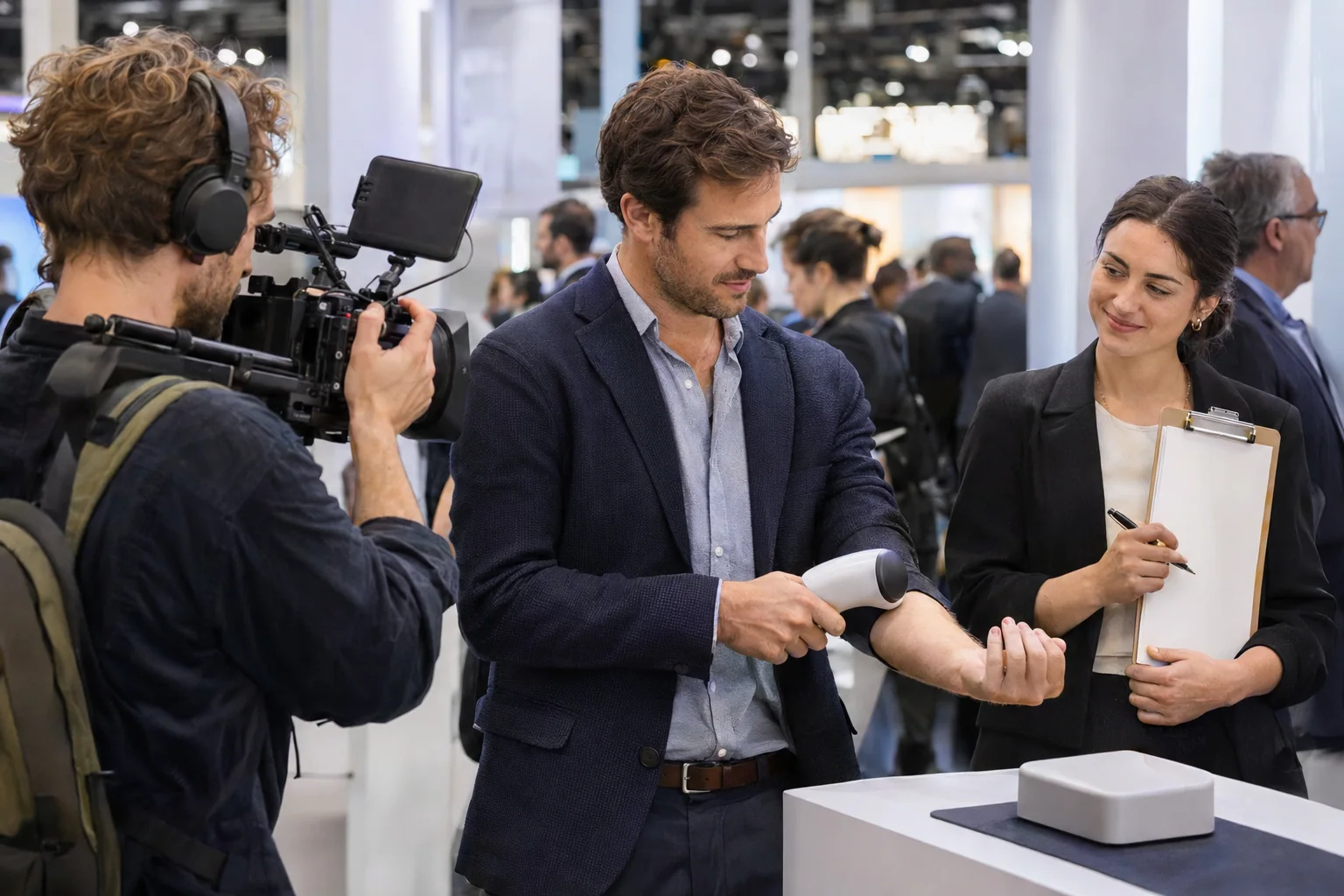
Write a shot list. Name the demo moments, the people you want on camera and the questions you will ask. Three good questions beat ten vague ones.
Get permission every time. Ask before you film a visitor, and get a signed release before you use a customer on camera.
Capture short customer reactions. A partner or customer explaining in their own words why they came to see you is the most believable thing you will bring home.
Film the demo the way a buyer sees it. Hands on the product, the screen readable, the result visible.
Record press moments you are allowed to use. Interviews and briefings make strong proof when the outlet agrees.
Post same day clips. A short clip on LinkedIn that evening puts the booth in front of people who are still at the show.
Real people saying unscripted things in a real place are hard to fake, and buyers increasingly look for exactly that. Our event coverage service exists to do this capture while your team focuses on selling.
The 30 days after CES: follow-up that sells
Most of the value of a booth is won or lost after Saturday. Leads that hear nothing for two weeks forget the conversation, and a rep who sends the same generic note as every other exhibitor gets ignored. Plan the follow-up before the show, so it is ready when the floor closes.
Within 48 hours: send a personal trade show follow up email to every scored lead. Mention what you talked about and attach one relevant clip from the floor.
First week: publish a CES recap page with the demo video, customer reactions and the main news. Send it to leads, customers and press.
Weeks two to four: run a short email and LinkedIn sequence by buyer role. A product engineer and a buyer need different proof, so give each the clip and the page that answers their question.
Retargeting: show the recap and customer clips to people who visited your CES pages before and after the show.
Sales enablement: give every rep a folder of approved clips they can send in a deal. A short clip of a peer often does more than any claim the brand makes about itself.
This is where search, content and paid media do their best work, because the proof you captured gives every channel something real to say. Our digital marketing team builds this follow-up as one plan rather than a set of separate tasks.
A composite example: one booth, three phases
The example below is a composite, not a real client: a mid-size consumer tech brand launching one product at CES.
Phase | What they do | What it produces |
|---|---|---|
Before | A launch page built around the problem the product solves, booth team posts on LinkedIn, personal invites to key accounts, a pitch to journalists from the media list | Booked meetings and press interest before arrival |
During | A shot list for demos, three customer interviews with signed releases, same day clips | A library of proof captured while customers are present |
After | A 48 hour follow-up with a clip, a recap page, a role-based sequence, retargeting | Follow-up that gives each lead a reason to take the next meeting |
The point of the example is the order. Each phase is planned before the show, so nothing depends on someone finding time in January.
Who runs this playbook
Whisenhunt Media is a Las Vegas digital marketing agency, based in the city since 2017, and on site for its largest conventions. We plan the search, LinkedIn, content and paid work around a show, and our team captures the proof on the floor, so the strategy and the footage are built together. Our work includes an Emmy Award for Special Event Coverage: Live, and customer-led proof programs such as the EnrollHere content and sales enablement engine. If you want more on why customer stories carry weight, read our guide to testimonial video.
The show lasts four days; the demand it creates should last all year.
Exhibiting at CES 2027? Book a planning call and we will map your before, during and after plan with you.
Free tool
See what AI says about your business
Kiki, our AI strategist, reads your real website in a live browser and hands you a personalized growth plan in about a minute. Free, no signup.
Analyze my business →Or start with how you sound: get your free Brand Voice Guide.
FAQ
When is CES 2027?
CES 2027 runs January 6 to 9, 2027, in Las Vegas, with Media Days on January 4 and 5. The exhibit floor opens at 10 AM on January 6 and closes at 4 PM on January 9. Confirm hours on the official CES site before you plan staffing.
How far ahead should CES exhibitors start marketing?
Start as soon as your booth is confirmed. Search and AI-answer visibility take weeks to build, the CES media list opens to exhibitors on December 1, and meetings book faster when invitations go out well before the holidays. The last weeks are for confirming meetings, not starting from zero.
How soon should we follow up with CES leads?
Within 48 hours of the floor closing. Send a personal note that mentions the conversation and includes something useful, such as a short clip of the demo. Then follow with a recap page and a sequence by buyer role over the next few weeks.
Can we film visitors and customers at our booth?
Yes, with permission. Ask before you film anyone, get a signed release before using a customer on camera, and check the CES exhibitor rules for your booth. Customer reactions captured this way become some of the most useful proof you bring home.
About Editorial Team
Editorial Team is part of the production team at Whisenhunt Media, writing from the projects the studio plans, shoots, and ships.